






 Multi-Vendor & Complex SaaS Marketplaces
 Modern Headless & Jamstack Web Development
 High-End Corporate & Specialized Business Websites
 Advanced API, Checkout & Database Troubleshooting
Shopify Dropshipping Setup Guide for Joondalup WA Sellers
Launch a scalable Shopify dropshipping store with clear DIY fixes for supplier sync, checkout, and theme conflicts—plus when Joondalup sellers should book remote Shopify support from Fixwebnode.

Joondalup and greater Perth sellers often stall between “store created” and “orders flowing cleanly”—wrong shipping zones, broken supplier sync, or apps fighting the theme. This guide walks you through a practical remote setup for a scalable Shopify dropshipping store, the failure modes we see most, and the exact checks you can run before you escalate.
If you need hands-on help, Fixwebnode Shopify Developer support works remotely with store owners in your area: configuration, app hygiene, payment and shipping alignment, and performance fixes—without marketplace bidding or freelancers in the middle.
Why a disciplined Shopify dropshipping launch matters
Dropshipping on Shopify looks simple until the first real order hits a wrong GST display, a supplier stock feed that is hours stale, or a theme section that hides the buy button on mobile. For small businesses around Joondalup, those failures cost trust faster than ad spend can replace it. A scalable store needs clean product data, reliable fulfilment handoff, Australian-friendly checkout, and a theme that stays fast as you add apps.
Fixwebnode provides direct Shopify support for this stack: we diagnose live store behaviour, tighten supplier and shipping setup, and stabilise the storefront so you can grow catalogue and traffic without constant firefighting. Remote sessions cover admin settings, theme code, app conflicts, and the server-side checks that sit behind custom domains and headless or multi-app setups.
Why is my Shopify dropshipping store not ready for real orders?
Most “almost live” stores fail on three fronts: inventory or pricing out of sync with the supplier, checkout or shipping rules that block Australian buyers, and theme or app conflicts that break product pages under load. Fix the data path and checkout path first; polish design only after orders can complete reliably.
| Symptom | Quick fix | When to call Fixwebnode |
|---|---|---|
| Stock shows available but supplier rejects the order | Re-auth the supplier app; force a full inventory sync; disable stale SKUs | Sync loops, duplicate SKUs, or API rate limits you cannot clear |
| Cart works but checkout errors or wrong shipping | Verify Payments, Markets, and shipping zones for Australia / WA | Gateway declines, GST/tax misrules, or multi-warehouse rate chaos |
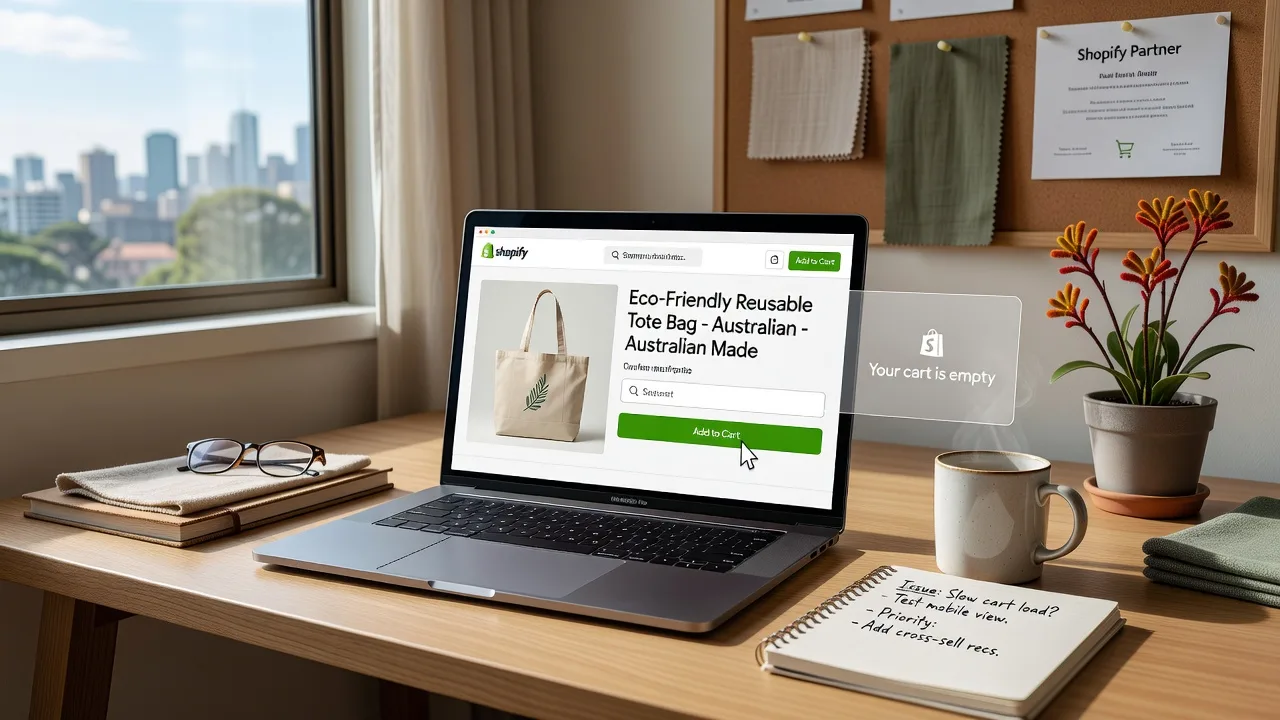
| Product page slow or Add to Cart missing | Disable recent apps; test in a duplicate theme; check console errors | Liquid/JS conflicts, Core Web Vitals collapse, or checkout extensibility bugs |
Common issues when launching a scalable dropshipping store
These problems show up repeatedly for new Shopify dropshipping operators. Each has a different root cause—treat them separately rather than reinstalling apps at random.
- Supplier inventory drift — Admin shows “in stock,” the supplier portal shows zero, or variants map to the wrong SKU after a CSV import.
- Australian checkout and shipping misconfiguration — Buyers in WA see empty shipping rates, unexpected duties language, or payment methods that never activate.
- Theme and app collision — After installing a reviews, upsell, or tracking app, the product form breaks, images fail to load, or mobile checkout feels stuck.
- Custom domain and HTTPS friction — Store loads on the myshopify.com URL but the branded domain loops, shows certificate warnings, or mixed-content blocks scripts.
- Unscalable catalogue structure — Hundreds of near-duplicate products without metafields, collections, or automated tagging, so search and ads cannot target cleanly.
Issue 1 — Supplier inventory and order-routing drift
Symptom: customers place orders; you get “out of stock” or wrong-item notices from the supplier within hours. Root cause is usually OAuth expiry, partial SKU mapping, or two apps writing inventory at once.
Step 1 — Confirm a single source of truth
- In Shopify Admin go to Settings → Apps and sales channels and list every app that can edit products or inventory.
- Disable or uninstall any second inventory writer you are not actively using.
- Open your primary supplier/dropship app and verify the store connection status is active (re-authenticate if the token is older than your last password change).
Step 2 — Force a clean inventory pull
- In the supplier app, run a full catalogue or inventory sync (not only “changed since last run”).
- Pick 5 high-risk SKUs and compare Shopify quantity, supplier quantity, and variant barcode/SKU character-for-character.
- For mismatches, unlink the variant, save, then re-link rather than editing quantity by hand (manual edits often get overwritten on the next sync).
Step 3 — Prove order routing with a test order
- Place a real low-value test order using a product you control.
- Confirm the order appears in the supplier dashboard with the correct SKU and shipping address format for Australia.
- Cancel or fulfil per your supplier’s test policy so you do not leave phantom stock holds.
Step 4 — Optional API sanity check (for technical owners)
If you use a private app or custom integration, verify the Admin API can read inventory without 401/429 errors. From a machine with your Admin API token stored securely:
curl -s -o /tmp/shopify_inv.json -w "%{http_code}\n" \
 -H "X-Shopify-Access-Token: $SHOPIFY_TOKEN" \
 -H "Content-Type: application/json" \
 "https://YOUR-STORE.myshopify.com/admin/api/2024-10/inventory_levels.json?limit=5"

python3 - <<'PY'
import json
p=json.load(open("/tmp/shopify_inv.json"))
print("levels" if "inventory_levels" in p else p)
PY
HTTP 200 with inventory levels means auth is fine; 401 means rotate the token; 429 means back off and reduce sync frequency. Never paste tokens into chat logs or public tickets.
When to call Fixwebnode: duplicate products after every sync, webhooks failing silently, or multi-supplier routing you cannot express in one app. Remote specialists map the data flow and lock a single write path.
Issue 2 — Checkout, payments, and shipping zones blocking WA buyers
Symptom: cart builds, then shipping rates are blank, Shopify Payments / gateway stays “pending,” or tax lines confuse local customers. Root cause is Markets, shipping profiles, or payment onboarding—not the theme.
Step 1 — Lock Markets and currency for Australia
- Open Settings → Markets. Ensure Australia is active with AUD as the presentment currency you intend to sell in.
- Remove test markets that dilute shipping rules if you are not ready for multi-country dropshipping.
- Under Settings → Taxes and duties, confirm GST settings match how you actually operate (do not guess legal obligations—align with your accountant, then mirror that choice in admin).
Step 2 — Rebuild shipping so Joondalup-to-customer rates resolve
- Go to Settings → Shipping and delivery.
- Create or edit a profile that includes your dropship products (general profile vs custom profile mistakes hide rates).
- Add zones covering Australia; set realistic flat or weight-based rates that match supplier postage plus your margin.
- If you use carrier-calculated rates, verify the origin address and package dimensions; empty dimensions often yield zero rates at checkout.
Step 3 — Validate payments end-to-end
- Complete identity and business details under Settings → Payments until the gateway shows as ready—not “action required.”
- Enable a backup method only after the primary path works; multiple half-configured gateways create intermittent declines.
- Run Shopify’s bogous order / test-mode flow appropriate to your gateway, then one live micro-purchase you can refund.
Step 4 — Browser-side checkout diagnostics
- Open the storefront in a private window, add a product, proceed to checkout.
- Open developer tools → Network; filter for failed requests (4xx/5xx) during shipping-rate load.
- Note any blocked third-party scripts (ad blockers, privacy extensions) if rates appear only in another browser—document that before blaming Shopify.
When to call Fixwebnode: rates work for Sydney postcodes but fail for WA, Markets conflict with legacy shipping profiles, or payment review loops with no clear admin error. We resolve this remotely against your live checkout.
Issue 3 — Theme and app collisions that break product pages
Symptom: Add to Cart missing, sticky ATC overlays covering content, Lighthouse performance collapsing after “just one more app,” or console errors referencing undefined theme sections.
Step 1 — Isolate with a duplicate theme
- Online Store → Themes → duplicate the live theme; never debug only on production.
- Publish the duplicate only if you need a true live A/B; otherwise use Preview.
- In the duplicate, disable app embeds one by one under Theme settings → App embeds.
Step 2 — Binary search the culprit app
- Disable half of the non-essential apps (upsell, pixel helpers, popups first).
- Retest the product template on mobile width.
- Re-enable in small batches until the break returns; uninstall or replace the offender rather than stacking “fix” apps.
Step 3 — Check storefront console and liquid assets
- Browser console: note red errors naming
theme.js, app CDNs, or checkout UI extensions. - In Theme editor, open the product template and confirm the main product section and buy-button block are enabled.
- If you edited code, compare against a clean copy of the same theme version; restore known-good sections instead of patching blindly.
Step 4 — Performance baseline for scale
- Run a performance scan on a product URL with apps on vs minimal embeds.
- Defer non-critical pixels until after purchase intent (thank-you / post-ATC) where platform rules allow.
- Compress hero images; avoid full-catalogue mega-menus on mobile if you plan large SKU counts.
When to call Fixwebnode: you need the app’s feature but the theme liquid is entangled, or checkout extensibility scripts fail only on certain devices. Remote theme surgery is faster than weeks of trial disable cycles.
Issue 4 — Custom domain, DNS, and HTTPS not sticking
Symptom: branded domain redirects oddly, “Not secure,” or assets still point at the old host. Dropshipping ads that land on certificate warnings convert poorly.
Step 1 — Connect the domain correctly in Shopify
- Settings → Domains → connect existing domain; set it as primary when Shopify verifies.
- At your DNS host, set the records Shopify shows (typically A/AAAA or ALIAS for apex, CNAME for
www). Remove leftover pointing to a former builder.
Step 2 — Verify DNS and TLS from the command line
dig +short yourdomain.com A
dig +short www.yourdomain.com CNAME
curl -sI https://www.yourdomain.com | head -n 15
openssl s_client -connect www.yourdomain.com:443 -servername www.yourdomain.com </dev/null 2>/dev/null | openssl x509 -noout -dates -subject
Confirm the A/CNAME targets match Shopify’s current guidance, that curl returns redirects to HTTPS without certificate errors, and that the certificate dates are valid. Propagation can lag; re-check rather than thrashing DNS every few minutes.
Step 3 — Clear stale SSL or CDN side effects
- If a reverse proxy or external CDN sits in front (uncommon but seen on migrated stacks), ensure it is not terminating SSL with an expired cert in front of Shopify.
- Purge any external cache once DNS is correct.
- Retest both apex and
wwwon mobile data, not only office Wi-Fi.
Owners who also run Linux origins for landing pages, webhooks, or middleware can lean on the same remote admin discipline we use elsewhere—see our Houston Linux Administration & Support Services and Montpelier, VT Linux Administration & Support runbooks for server-side TLS, reverse-proxy, and log checks that pair with Shopify-facing domains.
When to call Fixwebnode: split DNS across old hosts, email authentication colliding with store DNS, or middleware that signs webhooks and breaks after a domain cutover.
Issue 5 — Catalogue structure that will not scale
Symptom: paid traffic lands on thin or duplicate product pages; collections are manual chaos; you cannot filter by size, material, or supplier reliably.
DIY steps
- Define a naming convention: Brand + core product + key variant attribute in titles; keep SEO titles human, not keyword soup.
- Use product type and tags consistently; automate tags from the supplier app if it supports rules.
- Add metafields for attributes you will filter on later (material, wattage, bundle size)—do this before you hit 500 SKUs.
- Build automated collections from those tags/metafields instead of hand-picking every product.
- Archive supplier dead stock weekly so Google and Shopify search stay clean.
When to call Fixwebnode: bulk metafield migration, custom storefront filtering, or feed clean-up for Google Shopping after a messy import.
When DIY is enough vs when to book Fixwebnode
DIY is enough when you can complete a test order, shipping rates appear for Australian addresses, the primary domain serves HTTPS, and disabling one app restores a broken theme. Document each change so you can roll back.
Book Fixwebnode when failures span systems—supplier API plus checkout plus theme—or when downtime risks live ads. We are a direct specialist provider for Shopify dropshipping setup and remediation, working remotely with owners in Joondalup and across our service areas. You speak with the people doing the work; there is no freelance bidding queue.
Bring to the session: store staff access (or collaborator invite), supplier app name, list of recently installed apps, and one failing product URL plus a screenshot of any checkout error. That cuts diagnosis time sharply.
Next step: stabilise your storefront and ship with confidence
A scalable Shopify dropshipping store is less about installing more apps and more about clean inventory truth, honest shipping math, a theme that survives growth, and a domain customers trust. Work through the numbered checks above; if you still see sync loops, blank rates, or storefront breakage, get a specialist on the remote session early—before ad spend amplifies the fault.
Ready to talk through your build or rescue an almost-live shop? Start a conversation with Fixwebnode via the Shopify dropshipping store support page and outline your supplier stack, launch date, and the exact error you are hitting. We will map a practical path from setup to stable orders.