





 Multi-Vendor & Complex SaaS Marketplaces
 Modern Headless & Jamstack Web Development
 High-End Corporate & Specialized Business Websites
 Advanced API, Checkout & Database Troubleshooting
SSL/TLS Cipher Suite Hardening & Compliance Audit — Melbourne
Harden SSL/TLS cipher suites and prove compliance for Melbourne servers, apps, and gateways—without the guesswork.
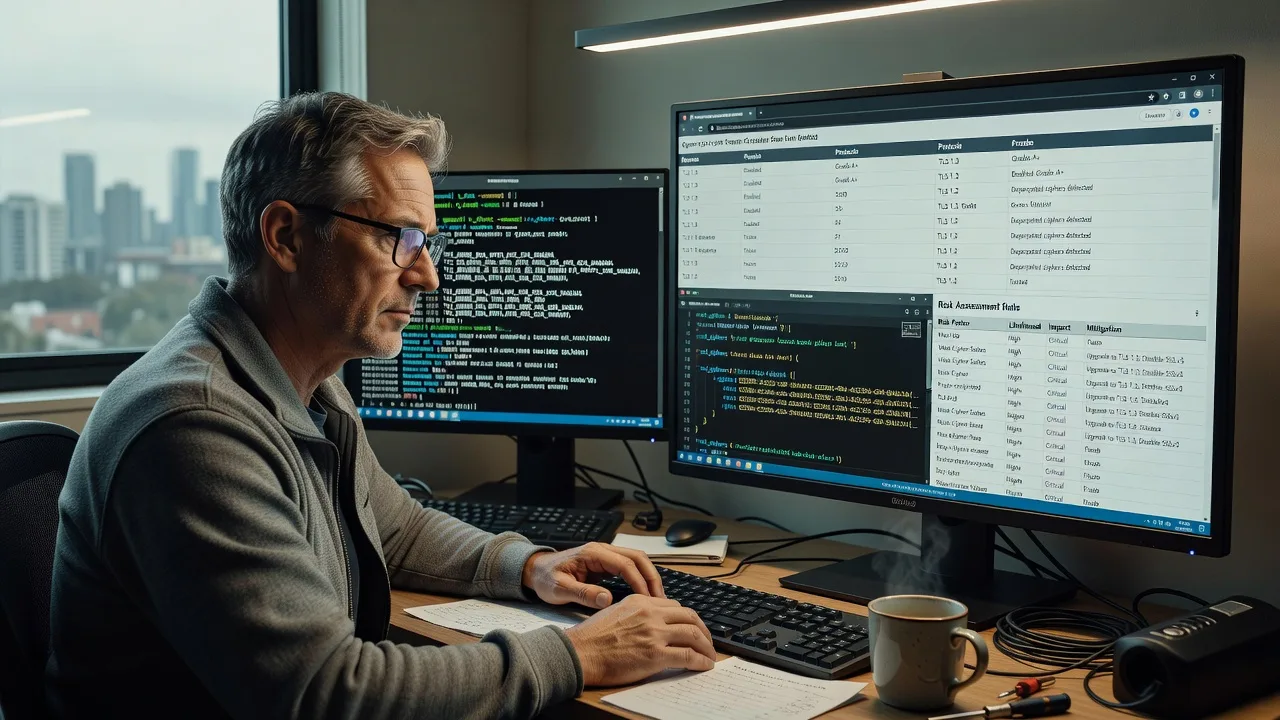
We audit weak protocols, legacy ciphers, and certificate chain gaps that trip PCI, ISO, and bank questionnaires for CBD SaaS teams, clinic portals, and warehouse logistics stacks. You get a clear risk report, safe remediations, and retest evidence you can hand to auditors.
Need it done properly? Call 0421498927 or book via fixwebnode.com.au/contact-support.
- Protocol & cipher inventory with risk ratings
- Hardening plan matched to your stack
- Post-change validation and plain-English handoff
About this service
Lock down outdated TLS ciphers and pass compliance checks for Melbourne production systems before the next pen-test or bank review flags them. We deliver direct cipher-suite hardening and evidence packs for your web, API, and mail endpoints—not a marketplace of bids.
What You'll Get
- Full TLS inventory - Protocols, cipher suites, key exchange, and certificate chain status across your public and internal endpoints
- Risk-ranked findings - Clear severity for weak CBC modes, RC4, 3DES, export ciphers, and TLS 1.0/1.1 still enabled by accident
- Hardening configuration pack - Ready-to-apply settings for nginx, Apache, IIS, HAProxy, load balancers, and common PaaS front doors
- Compliance mapping notes - How your new baseline aligns with PCI DSS, ASD Essential Eight crypto guidance, and common ISO control language
- Retest evidence - Before/after scan artefacts and a short handoff your ops or audit contact can file
- Optional monitoring path - Guidance so cipher drift does not creep back after the next platform update
Serving Melbourne & surrounds
Melbourne businesses sit on a mix of CBD multi-tenant SaaS, clinic booking portals, and industrial warehouse systems that still expose legacy TLS for “one partner integration.” Tourist and retail peaks push more traffic through payment and booking layers, so weak suites become both a security and an availability problem. We work remote-first across metro Melbourne and can schedule controlled change windows that respect your freight, clinic, or after-hours trading rhythms—including nearby Melbourne office stacks when you need a named contact on the change call.
- CBD and Melbourne SaaS teams needing clean auditor answers before QBR season
- High-street and strip retailers whose payment gateways still negotiate old suites under load
- Remote hardening with optional on-site liaison for data-centre or co-lo change freezes when your provider requires a human on the bridge
How We Work
- Step 1: Reach Out - Tell us your endpoints, stack, and whether this is a PCI, bank, insurer, or internal Essential Eight push—we listen first and note change-window constraints
- Step 2: Tailored Plan - Fixed-scope quote covering inventory, hardening, and retest depth (Basic through Premium)—no bidding, no freelancers
- Step 3: We Deliver - Remote assessment and configuration guidance, patient walkthrough of what will break if a partner still requires TLS 1.0, and staged apply where needed
- Step 4: Confirm & Follow-up - Plain-English handoff, retest proof, and optional follow-up session after your next platform upgrade
Common Issues & How to Fix Them
These are the failure patterns we see repeatedly on Melbourne production stacks—symptoms first, then safe DIY checks before you touch live cipher order.
Clients still negotiate TLS 1.0 or 1.1 even though “modern only” is in the docs
Often the edge (CDN, WAF, or load balancer) is modern while the origin or an old virtual host still offers legacy protocols, so scanners and partners see mixed results.
- Step 1: From a non-production machine run a protocol probe (e.g. openssl s_client -connect host:443 -tls1 and -tls1_1) and note whether the handshake completes
- Step 2: Disable TLS 1.0/1.1 only on the layer that actually terminates TLS; document any partner that still fails so you can grant a temporary exception path rather than re-enabling globally
- Step 3: Re-probe with -tls1_2 / -tls1_3 only and confirm a full handshake; store the command output as your baseline evidence
SSL Labs or internal scanners flag “weak cipher suites” after a platform upgrade
Default cipher strings on new AMI images, Windows Schannel templates, or managed reverse proxies often reintroduce CBC-only or non-PFS suites overnight.
- Step 1: Export the live cipher list (nginx: ssl_ciphers / ssl_conf_command; Apache: SSLCipherSuite; IIS: Get-TlsCipherSuite) and compare to your last known-good list
- Step 2: Apply an ordered modern suite list preferring AEAD (AES-GCM, ChaCha20-Poly1305) and ECDHE; remove RC4, 3DES, EXPORT, and NULL suites explicitly—do not rely on “HIGH” alone
- Step 3: Restart/reload the TLS terminator in a maintenance window, re-scan, and verify critical browsers and your payment or EDI partners still complete handshakes
Certificate is valid but mobile apps or older POS devices fail after hardening
Cipher and curve mismatch (missing secp256r1, or only X25519) or intermediate chain incomplete on some clients—not an expiry problem.
- Step 1: Capture a failing client handshake (server logs or a packet capture) and note offered curves, signature algorithms, and whether the client aborts after ServerHello
- Step 2: Ensure the full chain is served (leaf + intermediates), keep a widely supported ECDHE curve (P-256) alongside modern ones, and avoid dropping all RSA key-exchange if a constrained device still needs it until that device is upgraded
- Step 3: Retest the failing device class and a modern browser; document any temporary dual-stack cipher policy with an expiry date so weak suites do not become permanent
When DIY is not enough (urgent, unsafe, recurring, or burning time), book Fixwebnode for direct professional support—no freelancers, bidding, or marketplace noise.
Expert Insights
On Melbourne multi-tenant CBD stacks we repeatedly see “green” edge scores while the origin still offers TLS 1.0 because a warehouse EDI partner in the outer industrial belt was never cut over. The durable fix is not a single cipher string paste: inventory every TLS termination point (CDN, WAF, LB, origin, mail gateway), tag each with an owner and change window, then enforce a written exception register with review dates. Good looks like AEAD + PFS only on public edges, exceptions time-boxed and monitored. Bad looks like re-enabling TLS 1.0 globally the night before a freight peak because one device failed—then forgetting to reverse it. After five-plus years of these clean-ups, the teams that stay clean treat cipher policy like firewall rules: versioned, reviewed, and retested after every platform image bump.
Why Choose Fixwebnode
We are the direct provider: infrastructure hardening with human-clear explanations so your developers, clinic IT lead, or small-business owner can defend the change. Melbourne context matters—retail peaks, clinic hours, and warehouse cut-offs shape when we apply and retest.
- ✓ Direct fixed-scope delivery—we configure and validate, we do not auction your job
- ✓ Stack-aware guidance for nginx, Apache, IIS, HAProxy, and managed cloud front doors
- ✓ Evidence packs auditors and bank questionnaires actually accept, in plain English
Tools & Technologies
OpenSSL s_client and ciphers, testssl.sh / SSL Labs-style probes, nmap ssl-enum-ciphers, nginx/Apache/IIS/HAProxy cipher configuration, Let’s Encrypt and commercial chain validation, Qualys-style grading interpretation, Wireshark/tshark for failing handshakes, Git-tracked config baselines, and change-window runbooks aligned to PCI and Essential Eight crypto controls.
Perfect For
Melbourne SaaS and professional-services firms facing PCI or insurer questionnaires, clinics and telehealth portals that must keep patient booking paths trustworthy, and small-to-mid operators whose warehouse or multi-site apps still expose legacy suites. Ideal when you want one accountable specialist from inventory through retest—not a thread of competing proposals.
Ready to harden production TLS properly? Call 0421498927 or start at fixwebnode.com.au/contact-support.
Choose a package
Single public endpoint TLS inventory, risk summary, and recommended cipher baseline.
Multi-endpoint audit plus hardening guidance and one post-change retest cycle.
Organisation-wide TLS posture review, staged hardening support, evidence pack, and follow-up.
FAQ
Most SSL/TLS cipher hardening is delivered remotely with secure access to your edge and origin configs, which suits CBD SaaS, clinic portals, and distributed warehouse systems across Melbourne. If your data centre or co-lo provider requires a named person on the change bridge, we coordinate that window with you. Travel for hands-on liaison is arranged case-by-case when remote alone cannot satisfy the change control process.
It can, if a partner still requires TLS 1.0 or weak ciphers. We inventory first, flag high-risk clients, and use time-boxed exceptions where a device cannot move immediately—rather than leaving weak suites open forever. Standard and Premium scopes include retest after changes so you catch breakage before peak trading.
A list of hostnames and ports, who terminates TLS (CDN, load balancer, origin), any known PCI or bank questionnaire deadlines, and a preferred maintenance window. Read-only scan access is enough for Basic; Standard and Premium need a path to review or guide configuration changes under your change control.