





 Multi-Vendor & Complex SaaS Marketplaces
 Modern Headless & Jamstack Web Development
 High-End Corporate & Specialized Business Websites
 Advanced API, Checkout & Database Troubleshooting
Linux Kernel Patching & Zero-Downtime Updates — Melbourne
Keep Melbourne production Linux hosts patched without forced reboots or weekend outages.
We handle live kernel patching, staged rollouts, and zero-downtime update admin for CBD SaaS stacks, warehouse edge servers, and clinic backends that cannot drop sessions mid-shift. Clear fixed scopes, direct engineer delivery—no bidding layers.
Power up your next maintenance window: dial 0421498927 or book via fixwebnode.com.au/contact-support.
- Live patch paths where the kernel allows
- Change plans that respect freight and trading peaks
- Post-patch verification and plain-English handoff
About this service
We keep Melbourne Linux fleets current with controlled kernel patching and zero-downtime update admin so trading, clinic, and logistics systems stay online while security debt is closed. You get a direct specialist who owns the change window—not a queue of bid responses.
What You'll Get
- Kernel readiness assessment - Distro, live-patch capability, reboot risk, and module compatibility mapped before any package is applied.
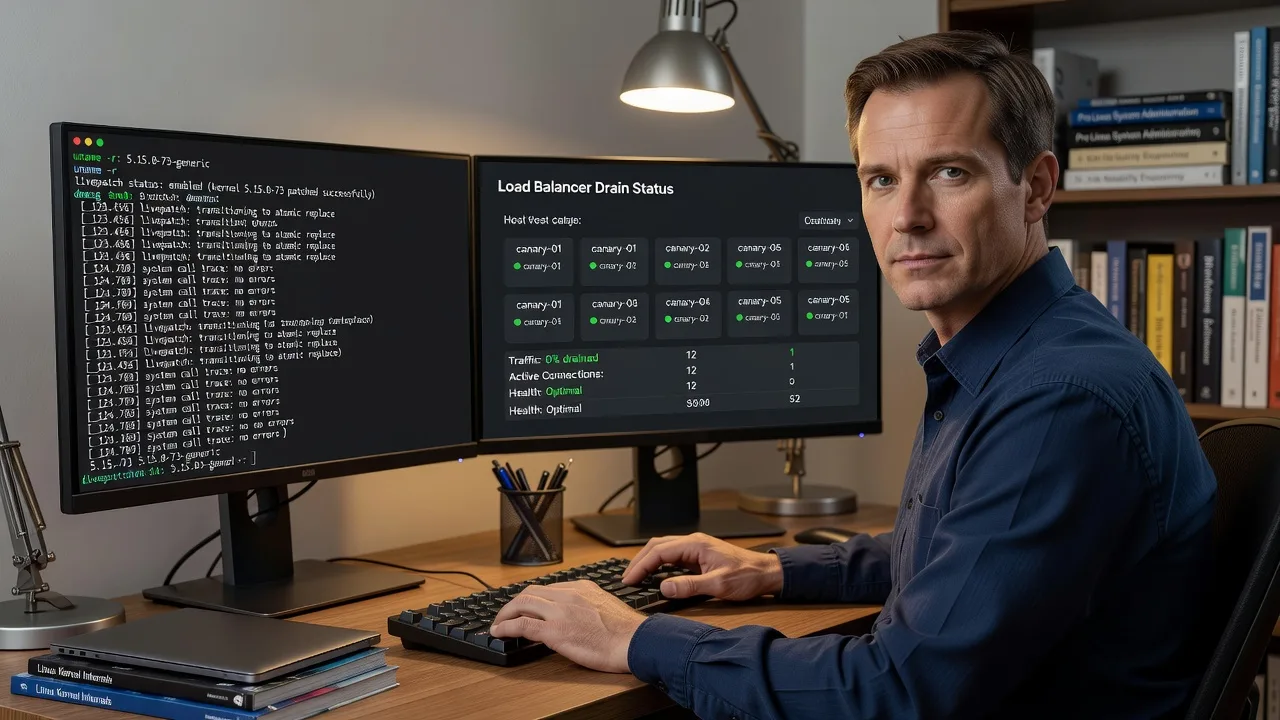
- Zero-downtime update plan - Staged hosts, canary nodes, drain/undrain steps, and rollback triggers written for your stack.
- Live kernel patching where supported - kpatch/livepatch-style paths on eligible kernels so critical CVEs land without a full reboot cycle.
- Coordinated package & kernel rollouts - apt/dnf/zypper sequencing that avoids half-upgraded states across load-balanced pairs.
- Post-update verification pack - Boot/kernel version checks, service health, dmesg review, and a short ops handoff note.
- Optional maintenance retainer path - Recurring CVE triage windows for teams that cannot staff every monthly patch Tuesday alone.
Serving Melbourne & surrounds
Melbourne operators feel patch pain differently by pocket: CBD multi-tenant app hosts hate session drops at lunch peaks; industrial and freight corridors need overnight windows that still respect interstate truck schedules; high-street and food precinct POS/back-office Linux boxes often sit on shared strata links with limited remote console access. We plan remote-first admin with on-site console coordination when a rack or NUC truly needs hands.
- CBD and inner-metro SaaS / agency stacks that must patch under load-balancer drain rules without customer-visible blips
- Warehouse and light-industrial edge Linux near freight routes where a failed reboot can stall barcode and WMS jobs until morning
- Remote-first delivery across metro Melbourne, with optional console meet-ups in Melbourne-style commercial racks or Preston-side workshop networks when physical access is the blocker
How We Work
- Step 1: Reach Out - Tell us distro, kernel series, host count, uptime SLAs, and whether live patching is already in play—we listen before we prescribe tools.
- Step 2: Tailored Plan - Fixed-scope quote for assessment-only, single-window patch, or multi-host zero-downtime campaign with clear success criteria.
- Step 3: We Deliver - Remote infrastructure work: readiness checks, live patches or controlled reboots, monitoring watches, and staged cutovers.
- Step 4: Confirm & Follow-up - Plain-English summary, kernel/version proof, residual risk notes, and optional next CVE window booking.
Common Issues & How to Fix Them
These are the failure modes we see repeatedly on Melbourne production Linux—not generic “run apt upgrade” advice.
Issue 1: “Patched” hosts still show the old running kernel after a successful package install
Packages landed, uname -r is unchanged, and security scanners still flag the bootable CVE because nobody completed the activate/reboot path—or livepatch never attached.
- Step 1: Record uname -r, installed kernel packages (rpm -q kernel or dpkg -l 'linux-image*'), and whether a livepatch tool is installed and licensed.
- Step 2: If livepatch is supported, apply the live patch set and confirm the patch module is loaded; if not, schedule a drained reboot into the new kernel rather than assuming install equals protect.
- Step 3: After activate/reboot, re-check uname -r, scanner findings, and that default GRUB entry points at the intended kernel—not a rescue entry left from last recovery.
Issue 2: Rolling updates flip half the cluster while the other half still runs modules that break ABI assumptions
Load-balanced nodes diverge mid-window: new kernel modules, old proprietary NIC/GPU/storage drivers, and odd segfaults only on “updated” members.
- Step 1: Inventory out-of-tree modules (lsmod, DKMS status, vendor driver packages) on a canary before touching the fleet.
- Step 2: Rebuild or pin vendor modules for the target kernel on the canary; only promote the batch when the canary survives traffic drain/undrain with clean dmesg.
- Step 3: Verify cluster parity with a simple matrix: kernel release, module versions, and service health on every node—halt the wave if any row drifts.
Issue 3: Live patch applies, then silently stops covering after a later userspace or tool update
Teams celebrate “no reboot,” then a tooling upgrade, subscription lapse, or kernel minor bump leaves livepatch inactive while dashboards still look green.
- Step 1: Check livepatch service state, entitlement/subscription, and loaded patch set IDs—not just that the package exists.
- Step 2: Re-enable or re-attach the patch stack; if the running kernel is outside the livepatch support window, plan a controlled reboot onto a supported baseline instead of forcing dead tooling.
- Step 3: Add a weekly audit job that alerts when running kernel ≠ expected baseline or livepatch inactive > N hours so silent drift cannot last a month.
When DIY is not enough (urgent CVE, unsafe reboot risk, recurring drift, or burning senior engineer time), book Fixwebnode for direct professional support—no freelancers, bidding, or marketplace noise.
Expert Insights
On Melbourne CBD multi-tenant app hosts we repeatedly see the same expensive mistake: operators drain only the HTTP backend and reboot, while a Redis/sidekiq or queue worker on the same box still holds locks—so clients see “brief blips” that are really lock storms. A good zero-downtime window drains every listener that owns state (HTTP, workers, cron that writes, local caches), waits for active connection gauges to hit your real zero (not just LB green), then patches. A bad window trusts the load balancer alone and learns about sticky sessions from pager noise. Before you touch kernel packages on a Friday freight peak, force a 10-minute dry-run drain on one canary during a quiet slice of the same weekday—you will discover which process still refuses to die while risk is still cheap.
Why Choose Fixwebnode
We are a direct Linux/infrastructure provider: one accountable path from readiness check to verified kernel, with empathy for non-stop Melbourne trading hours. You are not posting a job or comparing proposals—you are booking the team that runs the change.
- ✓ Live-patch and controlled-reboot playbooks shaped for production SLAs, not lab demos
- ✓ Melbourne-aware window planning for CBD peaks, industrial nights, and clinic hours
- ✓ Plain-English handoffs your on-call staff can re-run without decoding tribal notes
Tools & Technologies
RHEL/Rocky/Alma, Ubuntu LTS, SUSE; kpatch / Kernel Live Patching / Canonical Livepatch where licensed; apt, dnf, zypper; GRUB inspection; systemd; drain scripts for nginx/haproxy/envoy; SSH jump hosts; Prometheus/node_exporter or existing APM watches; DKMS and common vendor NIC/storage modules; change runbooks and rollback tags in your tracker.
Perfect For
Melbourne SaaS, logistics, clinic, and professional-services teams running Linux that must absorb CVEs without advertising downtime to customers or ward staff. Ideal when you already have monitoring and backups but lack a specialist to own kernel risk end-to-end on a fixed quote.
Ready to close kernel debt without a scary reboot lottery? Call 0421498927 or start at fixwebnode.com.au/contact-support.
Choose a package
Single-host kernel readiness check plus guided patch or livepatch activate plan with verification notes.
Multi-host zero-downtime window: canary, staged rollout, livepatch or controlled reboot, and ops handoff.
Fleet-grade kernel programme: inventory, livepatch policy, multi-wave rollout, rollback drills, and 30-day follow-up.
FAQ
Most kernel patching and zero-downtime admin is delivered remotely across Melbourne with secure jump access. If a host lacks remote console, sits in a locked commercial rack, or needs hands on a crash cart, we coordinate a scheduled on-site assist for metro locations and keep the change plan under the same fixed scope.
When the distro and kernel series support a live patch stack and your subscription/tooling is healthy, we prioritise live patching for eligible CVEs. If the kernel is outside support, modules block live patch, or a cumulative baseline is overdue, we design a drained controlled reboot so uptime impact stays planned—not accidental.
Distro and kernel versions, approximate host count, load-balancer or failover topology, known out-of-tree drivers, preferred change window, and monitoring access. Backups or snapshots for stateful nodes should already exist; we will confirm that before applying kernel packages.
Yes. Basic, Standard, and Premium are fixed scopes we deliver directly as Fixwebnode. After intake we confirm host count and risk class so the package still matches reality; you are not collecting bids or managing freelancers.